

What If Adventure Time Was 3d Anime Game Download
If y'all've spent some time in your life playing video games, you might be familiar with the feel of seeing something new — a new perspective, a new controller, a hyper-realistic cutting-scene, you lot proper noun it — and feeling totally overwhelmed. It feels similar yous'll never go used to information technology, but then, pretty soon, by some miracle, you manage to suit and conform. Every bit a person who is old enough to have had an original Nintendo console as a child, this scenario has happened more times to me than I'd care to acknowledge.
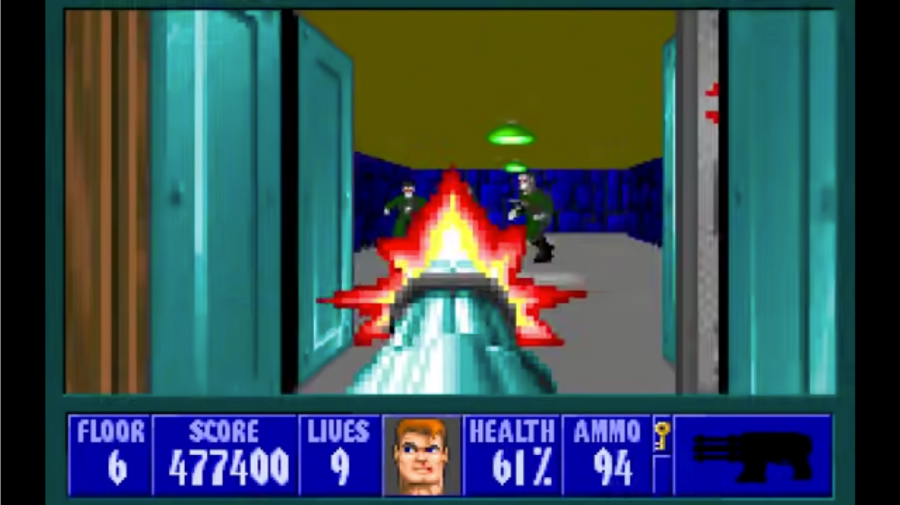
This month marks the 30th anniversary of the groundbreaking offset-person shooter game Wolfenstein 3D. I have bright memories of being at a family dinner with friends of my parents, seeing their kids play Wolfenstein 3D on their estimator; my listen was completely blown. Everything seemed to exist moving so fast; everything seemed to be coming right at me. I had never seen anything like it.
While in that location were first-person video games before Wolfenstein 3D and much better ones that came later on it and congenital on its legacy, its release was a watershed moment in the history of wasting time on the calculator. Here, we'll get into the history of the genre, why Wolfenstein 3D felt like such a large deal at the time, and why perspective is always ground for interesting experiments in video games.
The Development of First-Person Perspective in Video Games
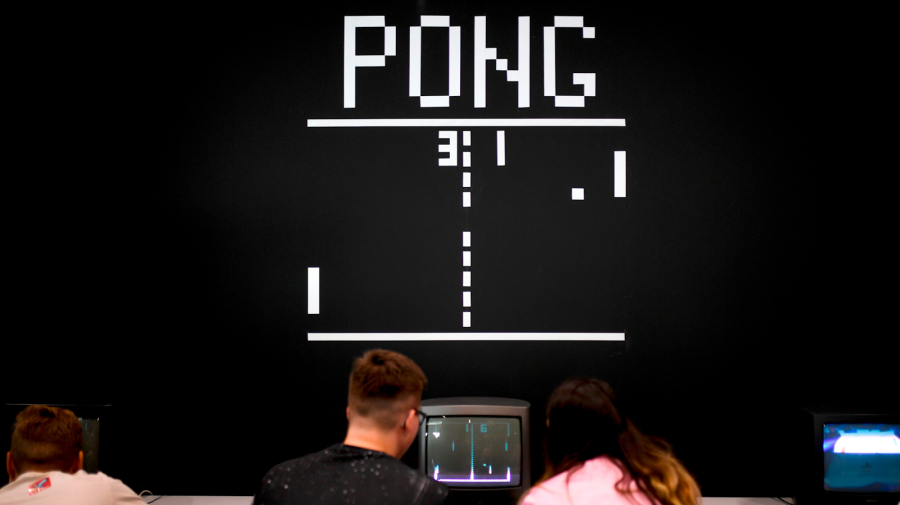
It seems like a pretty obvious development now, only it took a while for people to figure out how to implement first-person perspective into a virtual feel. The first video game is more often than not considered to take been Tennis for Ii, created in 1958 by a man named William Higinbotham. It involved a side-view of a tennis courtroom crudely rendered on an oscilloscope screen. The ball, as you can imagine, was sent dorsum and forth. It was a lot like Pong, which came along 14 long years subsequently.
Of class, inventiveness cannot be stopped. In 1973, Maze War, the first game that could technically be called a get-go-person shooter, came out. That means each role player could move nigh the titular maze in such a way that the view would be what you might run into if you were plopped into the maze yourself. While the rendering was still profoundly simple — green lines producing a series of 3D hallways —Maze War captured all the most important elements of first-person video games.
First-person perspective had been used prior to Maze State of war in simple racing games or in gallery shooter games similar to the famous Nintendo game, Duck Hunt, in which a player fires at moving targets on an otherwise static screen. Maze War's improver of other, networked players added an element of a living, changing, unpredictable experience that is at the center of everything that'due south so addictive most video games. As Maze War creator Steve Solley put it, "Maze was popular at first but rapidly became tiresome…and soon the idea for shooting each other came forth, and the first-person shooter was born."
In the nearly 20 years between Maze War and Wolfenstein 3D, a lot happened in video games. I'm not going to go into all of that here, but suffice to say that by 1992, the technology of video games had advanced to the betoken that an evolutionary spring was possible. Wolfenstein 3D, due to a combination of factors, was the game that capitalized on the moment.
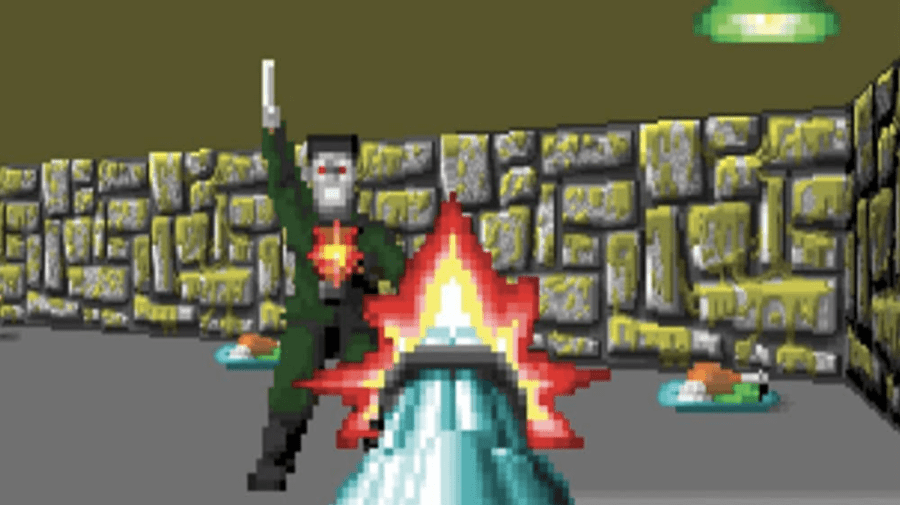
Offset, there was the game itself. In Wolfenstein 3D, you are William "B.J." Blazkowicz, an American spy who must beginning escape from the fictional Nazi prison, Castle Wolfenstein, so end a Nazi plot to create an army of zombie mutants. The game culminates in a battle against Adolf Hitler in some sort of robotic, machine-gun wielding arrange.
All of that plot is secondary to the mechanics of the game, though. More any of the first-person games before it, Wolfenstein 3D had smoothness to its movements, and you lot could move and await around in 360 degrees. The graphics seem absurdly rudimentary at present, but they looked incredible in 1992. It's hard to go back in time and remember how things felt, but trust me: playing Wolfenstein 3D felt like a bounding main alter. For the first time, a video game made me kinda feel like I was there.
Kickoff-Person Shooters Since Wolfenstein 3D
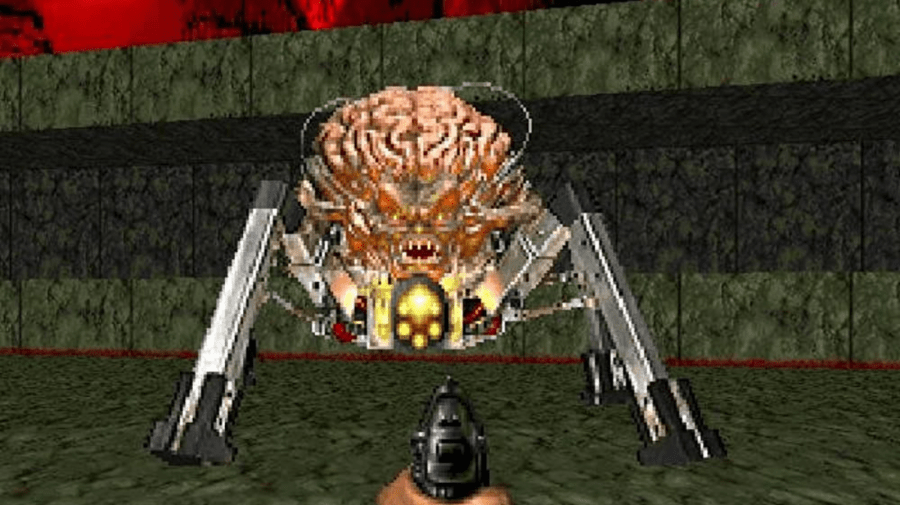
Nearly immediately subsequently Wolfenstein 3D, fifty-fifty improve first-person shooters started popping upwards as the visitor that produced it — id Software — followed it up with Doom in 1993 and Convulse in 1996. Doom, in particular, took everything that Wolfenstein 3D did and made it even bigger: higher resolution graphics, smoother gameplay, and amped-up levels of violence and gore. Doom was such a major hit that it ended up spawning a flick starring The Rock in 2005.
In the context of video games though, these games, along with 1994'due south Descent from Parallax Software, created the foundation for everything that came after in the genre of first-person shooters. Over the next decade, Halo, Medal of Honour, Call of Duty and other first-person shooter franchises started coming out. As of today, these franchises take been pumping out first-person shooter content for ii total decades, and they show no signs of slowing downwardly.
Gimmicky first-person shooter games are hyper-realistic. The fashion the first-person perspective moves through whatever given landscape feels uncanny — nearly human. Looking at Wolfenstein 3D now doesn't give you that feeling, only I hope you: back in the early 90s, information technology did. The DNA of today's games is correct there for yous to run into.
Experiments in Perspective
Of course, showtime-person perspective in video games went beyond the incredibly elementary idea of shooting stuff with a gun. It'south always been true that video games are a version of virtual reality, merely the first-person perspective takes that truism to its purest level. For example, 1993's Myst, a computer game in which the actor explores a mysterious isle through a series of puzzle challenges, was a much quieter exploration of the possibilities of showtime-person perspective, and it managed to be an enormous hit in the early 1990s too.
I love first-person shooters. They're exciting to play, and the feel of playing them with and against friends is really hilarious and fun. However, running around shooting stuff and bravado stuff upwardly gets old afterward a while, doesn't it? Maybe after all these decades of exploring the first-person perspective in video games, the virtually interesting experiences and experiments are happening elsewhere.

That brings me to Everything, the 2017 game from the artist David OReilly. Everything isn't in beginning-person perspective — the player sees the vessel through which they motility effectually and explore the procedurally-generated universe. The innovation is that the vessel changes; equally you wander around, you can embody the consciousness of anything y'all meet. Want to be a moo-cow? Be a cow for a while. Desire to be a blade of grass that a moo-cow might eat? Go for it.
Everything has no goals beyond exploration, really. While you wander around, y'all listen to quotes from the philosopher Alan Watts. The whole thing is very meditative. Nevertheless, when I played information technology for the first time, I found myself thinking about Wolfenstein 3D and the offset-person shooter games of my adolescence. I thought about how every then often a video game comes along that changes the fashion I think most things — the way I experience the world around me. Video games can exist overblown and empty-headed, and maybe nosotros spend as well much time and energy on them, but sometimes they are a reminder of our chapters for creativity and wonder, too.
Source: https://www.ask.com/culture/wolfenstein-3d-and-the-first-person-shooter?utm_content=params%3Ao%3D740004%26ad%3DdirN%26qo%3DserpIndex
Posted by: stewardexcums.blogspot.com
0 Response to "What If Adventure Time Was 3d Anime Game Download"
Post a Comment