

What Animal Eats Coffee Beans And Poops Them Out
 | |
| Place of origin | Indonesia[1] |
|---|---|
| Main ingredients | Coffea arabica |
| |
 Media: Kopi luwak
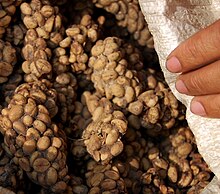
Kopi luwak is a coffee that consists of partially digested coffee cherries, which have been eaten and defecated by the Asian palm civet (Paradoxurus hermaphroditus). It is besides chosen civet coffee. The cherries are fermented equally they pass through a civet's intestines, and afterwards being defecated with other fecal matter, they are nerveless.[1] Asian palm civets are increasingly caught in the wild and traded for this purpose.[two]
Kopi luwak is produced mainly on the Indonesian islands of Sumatra, Java, Bali, Sulawesi, and in East timor. It is also widely gathered in the forest or produced in farms in the islands of the Philippines,[3] where the product is called kape motit in the Cordillera region, kapé alamíd in Tagalog areas, kapé melô or kapé musang in Mindanao, and kahawa kubing in the Sulu Archipelago. Weasel java is a loose English translation of its Vietnamese name cà phê Chồn.
Producers of the coffee beans contend that the process may improve coffee through two mechanisms: selection – civets choosing to consume only certain cherries, and digestion – biological or chemical mechanisms in the animals' digestive tracts altering the composition of the coffee cherries.
The traditional method of collecting feces from wild Asian palm civets has given way to an intensive farming method, in which the palm civets are kept in bombardment cages and are force-fed the cherries. This method of production has raised upstanding concerns about the treatment of civets and the atmospheric condition they are made to live in, which include isolation, poor nutrition, pocket-size cages, and a high mortality rate.[4] [v] [six]
Although kopi luwak is a form of processing rather than a variety of java, it has been called ane of the nigh expensive coffees in the world, with retail prices reaching United states$100 per kilogram for farmed beans and US$ane,300 per kilogram for wild-collected beans.[7]
History [edit]
The origin of kopi luwak is closely connected to the history of coffee production in Indonesia.[8] Dutch colonialists established java plantations in Indonesia and imported beans from Yemen. In the 19th century, farmers in central Coffee started to mash and drinkable java from excreted beans nerveless in their plantations.[9]
Production [edit]


Kopi luwak is brewed from coffee beans that transversed the alimentary canal of an Asian palm civet, and were thus subjected to a combination of acidic, enzymatic, and fermentation treatment. During digestion, digestive enzymes and gastric juices permeate through the endocarp of coffee cherries and break down storage proteins, yielding shorter peptides. This alters the composition of amino acids and impacts the smell of the java. In the roasting procedure, the proteins undergo a non-enzymatic Maillard reaction.[ten] The palm civet is thought to select the most ripe and flawless coffee cherries. This pick influences the flavour of the coffee, as does the digestive procedure. The beans begin to germinate by malting, which reduces their bitterness.[eleven] When performed in nature, or in the wild, these 2 mechanisms attain the same goal equally selective picking and the moisture or done process of coffee milling: 1) harvesting optimally ripe cherries and ii) mechanically and chemically removing the lurid and skin from the crimson, leaving mainly the seed.[12]
Traditionally, excreted coffee beans were collected straight in plantations and forests. As the international demand for kopi luwak increased, some producers turned to caged production methods to increment yields. In 2014, the annual kopi luwak product was grossly estimated at less than 127 kg. It is produced in Indonesia, Democratic republic of timor-leste, the Philippines, Thailand, Vietnam and Ethiopia.[13]
Taste [edit]

A cup of kopi luwak from Gayo, Takengon, Aceh
The sense of taste of kopi luwak varies with the blazon and origin of excreted beans, processing, roasting, crumbling, and brewing. The ability of the civet to select its berries, and other aspects of the civet'south diet and health, like stress levels, may also influence the processing and hence sense of taste.[fourteen]
Within the coffee industry, kopi luwak is widely regarded as a gimmick or novelty item. The Specialty Coffee Association of America (SCAA) states that there is a "general consensus within the manufacture...it just tastes bad". A coffee professional compared the same beans with and without the kopi luwak process using a rigorous java cupping evaluation. He ended: "information technology was credible that luwak java sold for the story, not superior quality...Using the SCAA cupping scale, the luwak scored two points beneath the lowest of the other three coffees. Information technology would appear that the luwak processing diminishes good acerbity and flavor and adds smoothness to the body, which is what many people seem to note as a positive to the java."[xv] Professional coffee tasters were able to distinguish kopi luwak from other coffee samples, but remarked that information technology tasted "thin".[16] Some critics merits more generally that kopi luwak is simply bad coffee, purchased for novelty rather than taste.[xv] [17] [18] A nutrient writer reviewed kopi luwak available to American consumers and concluded "Information technology tasted just similar...Folgers. Stale. Lifeless. Petrified dinosaur droppings steeped in bathtub h2o. I couldn't finish it."[nineteen]
Imitation [edit]
Several commercial processes attempt to replicate the digestive process of the civets without beast involvement. Researchers with the University of Florida have been issued with a patent for one such process.[20] [21] Brooklyn-based food startup Afineur has also developed a patented fermentation technology that reproduces some of the taste aspects of Kopi Luwak while improving coffee edible bean taste and nutritional contour.[22] [23] [24]
Vietnamese companies sell an imitation kopi luwak, fabricated using an enzyme soak which they merits replicates the civet's digestive process.[25]
Imitation has several motivations. The high price of kopi luwak drives the search for a style to produce kopi luwak in large quantities. Kopi luwak production involves a great bargain of labour, whether farmed or wild-gathered. The small production quantity and the labor involved in production contribute to the coffee's high cost.[26] Imitation may exist a response to the subtract in the civet population.[27]
Animate being welfare [edit]
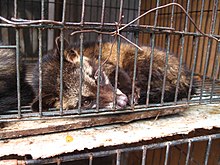
Asian palm civet in a cage
Growing numbers of intensive civet "farms" have been established and are operated in Southeast Asia, circumscribed tens of thousands of animals to alive in bombardment cages and be forcefulness-fed.[28] [29] [xxx] "The conditions are awful, much like battery chickens", said Chris Shepherd, deputy regional director of TRAFFIC in Southeast Asia. "The civets are taken from the wild and have to endure horrific conditions. They fight to stay together but they are separated and have to bear a very poor diet in very small-scale cages. There is a high bloodshed rate and for some species of civet, there'due south a existent conservation take chances. Information technology is spiraling out of control".[4] The trade in palm civets for the production of kopi luwak may constitute a significant threat to wild populations.[2]
In 2013, People for the Ethical Treatment of Animals (PETA) investigators found wild-caught civets on farms in Republic of indonesia and the Philippines. They were deprived of practise, proper diet, and space. Video footage from the investigation shows aberrant behaviours such as repeated pacing, circling, or bitter the confined of their cages. The animals often lose their fur.[31] A BBC investigation revealed similar conditions. Farmers using caged palm civets in northward Sumatra confirmed that they supplied kopi luwak beans to exporters whose produce ends up in Europe and Asia.[6] Tony Wild, the java executive responsible for bringing kopi luwak to the Western earth, has stated he no longer supports using kopi luwak due to animate being cruelty and launched a campaign called "Cut the Crap" to halt the use of kopi luwak.[32]
Price and availability [edit]

A window display in an upscale coffee shop showing kopi luwak in forms of defecated clumps (lesser), unroasted beans (left) and roasted beans (right)
Kopi luwak is one of the most expensive coffees in the earth, selling for between $220 and $i,100 per kilogram ($100 and $500/lb) in 2010. The price paid to collectors in the Philippines is closer to US$20 per kilogram.[14] The specialty Vietnamese weasel coffee, which is made by collecting coffee beans eaten by wild civets, is sold at US$500 per kilogram.[33] Most customers are Asian, especially those originating from Japan, People's republic of china, and South Korea.[34]
Some specialty coffee shops sell cups of brewed kopi luwak for US$35–eighty.[35] [36] [37]
Authenticity and fraud [edit]
Investigations by PETA and the BBC found fraud to be rife in the kopi luwak industry, with producers willing to label java from caged civets with a "wild sourced" or similar characterization.[31] [6]
Genuine kopi luwak from wild civets is difficult to purchase in Indonesia and proving it is not fake is very difficult – there is niggling enforcement regarding utilize of the proper name "kopi luwak", and there's even a local cheap coffee brand named "Luwak", which costs nether US$3 per kilogram just is occasionally sold online under the guise of real kopi luwak.
Variations [edit]
At that place are reports of a kopi luwak type process occurring naturally with muntjac and birds. Bat java is another variation that is in demand. Bats feed on the ripest coffee and fruits and spit out the seeds. These seeds are dried and candy to make coffee with a slight fruity flavor.[38] [39]
In popular culture [edit]
In the film The Saucepan Listing, billionaire health intendance magnate Edward Cole (played by Jack Nicholson) enjoys drinking kopi luwak, but is unaware of how it is produced. Carter Chambers (Morgan Freeman) explains how civets defecate kopi luwak coffee beans and that its gastric juices give the unique aroma to this coffee.
The Japanese manga series Beastars features an anthropomorphic civet character that produces kopi luwak.[twoscore]
See also [edit]
- Balinese cuisine
- Black Ivory coffee
- List of Indonesian beverages
- Insect tea
- Panda tea
References [edit]
- ^ a b Mahendradatta, M.; Tawali, A. B. (2012). Comparison of chemical characteristics and sensory value between luwak java and original coffee from Prc (Coffea arabica L) and Robusta (Coffea canephora Fifty) varieties (PDF). Makassar: Food Science and Technology Report Program, Department of Agronomical Technology, Kinesthesia of Agriculture, Hasanuddin Academy.
- ^ a b Shepherd, C. (2012). "Observations of small-scale carnivores in Jakarta wild animals markets, Indonesia, with notes on trade in Javan Ferret Badger Melogale orientalis and on the increasing demand for Common Palm Civet Paradoxurus hermaphroditus for civet coffee product". Small Carnivore Conservation. 47: 38–41.
- ^ Ongo, East.; Montevecchi, One thousand.; Antonelli, A. (2020). "Metabolomics fingerprint of Philippine coffee by SPME-GC-MS for geographical and varietal classification". Nutrient Research International. 134: 109227. doi:10.1016/j.foodres.2020.109227. hdl:11380/1200548. PMID 32517906. S2CID 216380024.
- ^ a b Milman, O. (2012). "World's most expensive coffee tainted past 'horrific' civet corruption". The Guardian . Retrieved 25 November 2012.
- ^ Penha, J. (2012). "Excreted by imprisoned civets, kopi luwak no longer a personal favorite". The Jakarta Globe . Retrieved 17 August 2012.
- ^ a b c Lynn, G.; Rogers, C. (2013). "Civet cat coffee'south creature cruelty secrets". BBC News . Retrieved 16 September 2013.
- ^ "What Is the Price of Kopi Luwak? (Total Breakdown for 2021-22)". 11 Coffees. nine March 2020. Retrieved 27 Oct 2020.
{{cite web}}: CS1 maint: url-status (link) - ^ "Kopi Luwak Coffee Review". www.coffeecafe.meridian. nine June 2022. Retrieved 12 June 2022.
- ^ Ifmalinda; Setiasih, I.Southward.; Muhaemin, Yard. & Nurjanah, Due south. (2019). "Chemic Characteristics Comparing of Palm Civet Coffee (Kopi Luwak) and Arabica Coffee Beans". Periodical of Practical Agronomical Scientific discipline and Technology. iii (two): 280–288. doi:10.32530/jaast.v3i2.110.
- ^ Marcone, M. (2004). "Limerick and properties of Indonesian palm civet java (Kopi Luwak) and Ethiopian civet coffee" (PDF). Food Research International. 37 (9): 901–912. doi:10.1016/j.foodres.2004.05.008.
- ^ Marcone, M. (2007). In Bad Taste? The Adventures and Science behind Nutrient Delicacies . Toronto: Fundamental Porter Books. ISBN9781552638828.
- ^ Hasni, D; Rahmi, F.; Muzaifa, M; Syarifudin (2019). "What is kopi luwak? A literature review on product, quality and problems". IOP Conference Series: Globe and Environmental Science. 365 (1): 012041. Bibcode:2019E&ES..365a2041M. doi:10.1088/1755-1315/365/one/012041.
- ^ D'Cruze, N.; Toole, J.; Mansell, Thousand. & Schmidt-Burbach, J. (2014). "What is the true cost of the world'due south nearly expensive coffee?". Oryx. 48 (2): 170–171. doi:ten.1017/S0030605313001531.
- ^ a b Onishi, North. (2010). "From dung to coffee mash with no aftertaste". The New York Times.
- ^ a b Kubota, 50. (2011). "The value of a good story, or: How to plow poop into gold". Specialty Java Clan of America . Retrieved 25 August 2012.
- ^ Kleiner, K. (2004). "Bean there, dung that". New Scientist. Vol. 184, no. 2469. pp. 44–45.
- ^ Hetzel, A. (2011). "Kopi Luwak: marvel kills the civet cat". Coffee Quality Strategies . Retrieved 25 Baronial 2012.
- ^ Sinclair, 50. (2011). "Just say no to kopi luwak". Sprudge . Retrieved 25 August 2012.
- ^ Carman, T. (2012). "This Sumatran civet coffee is cra...actually terrible". The Washington Postal service.
- ^ "Quality enhancement of java beans by acid and enzyme treatment". Reeis.usda.gov . Retrieved 17 Nov 2011.
- ^ "Quality Enhancement of Coffee Beans by Acid and Enzyme Treatment". Faqs.org . Retrieved 17 November 2011.
- ^ Andrey Smith, P. (21 January 2016). "Better Coffee Through Bacterial Chemistry". Bloomberg.com . Retrieved seven July 2016.
- ^ Zimberoff, L. (2015). "How a New Startup Is Refining the Flavor of Coffee via Microbial Fermentation". Eater . Retrieved 7 July 2016.
- ^ Wurgaft, B. (2014). "Vegan Kopi Luwak? Biotech'southward Cruelty Free Coffee Fermentation". Sprudge. Sprudge. Retrieved 7 July 2016.
- ^ "Legendee: The Fable of the Weasel". trung-nguyen-online.com . Retrieved 18 Feb 2010.
- ^ "Characteristic by WBAL Channel 11 television news squad". Youtube. 2010. Archived from the original on 3 November 2021. Retrieved 17 Nov 2011.
- ^ "Vietnam species 'take chances extinction'". BBC News. 2009.
- ^ Wild, T. (2014). "Civet cat java: can world's most expensive mash exist made sustainably?". The Guardian.
- ^ "Civet cat coffee: A delicious beverage or a case of animal cruelty?". ABC News. 2015.
- ^ "Coffee, civets and conservation". The Sunday Times Sri Lanka. 2015.
- ^ a b "Kopi Luwak Investigation". PETA Asia . Retrieved 17 Oct 2013.
- ^ Wild, T. (2013). "Civet coffee: Why it's time to cut the crap". The Guardian.
- ^ Thout, B. M. (2012). "Java in Vietnam: It'south the shit". The Economist . Retrieved 10 Nov 2013.
- ^ McGeown, K. (2011). "Civet passes on hole-and-corner to luxury coffee". BBC News.
- ^ "Kopi Luwak". Heritage tea rooms. 2007. Retrieved 18 February 2010.
- ^ "The £50 espresso". The Guardian. 2008. Retrieved xviii February 2010.
- ^ Bale, R. (2016). "The Disturbing Underground Behind the World's Nigh Expensive Coffee". National Geographic . Retrieved 31 March 2019.
- ^ "Bat Java Coorg". Otters Creek River Resort Coorg Nagarhole. 2018. Archived from the original on 9 February 2018.
- ^ Abrams, L. (2013). "Are you lot fancy plenty for bird poop coffee?". Salon.
- ^ Itagaki, Paru (2020). Beastars Volume 17. Akita Shoten. ISBN978-4-253-22905-0.
Further reading [edit]
- Jumhawan, U.; Putri, S. P.; Yusianto; Marwani, E.; Bamba, T.; Fukusaki, E. (2013). "Selection of Discriminant Markers for Authentication of Asian Palm Civet Coffee (Kopi Luwak): A Metabolomics Approach" (PDF). Journal of Agricultural and Nutrient Chemistry. 61 (33): 7994–8001. doi:10.1021/jf401819s. PMID 23889358. Archived from the original (PDF) on 31 May 2019.
- Jumhawan, U.; Putri, Due south. P.; Yusianto; Bamba, T.; Fukusaki, East. (2016). "Quantification of coffee blends for authentication of Asian palm civet coffee (Kopi Luwak) via metabolomics: A proof of concept". Journal of Bioscience and Bioengineering. 122 (ane): 79–84. doi:10.1016/j.jbiosc.2015.12.008. PMID 26777237.
- Jumhawan, U.; Putri, S. P.; Yusianto; Bamba, T.; Fukusaki, East. (2015). "Application of gas chromatography/flame ionization detector-based metabolite fingerprinting for authentication of Asian palm civet java (Kopi Luwak)" (PDF). Journal of Bioscience and Bioengineering. 120 (v): 555–561. doi:x.1016/j.jbiosc.2015.03.005. PMID 25912451. Archived from the original (PDF) on 31 May 2019.
- Sulihkanti, A.; Wahyudi, T.; Tunjung Sari, A. B. (2012). "Assay of luwak coffee volatile past using solid stage microextraction and gas chromatography (Analisa senyawa volatil kopi luwak dengan menggunakan mikroekstrasi fase padat dan kromatolgi gas)". Pelita Perkebunan. 28 (ii): 111–118. doi:10.22302/iccri.jur.pelitaperkebunan.v28i2.204.
Source: https://en.wikipedia.org/wiki/Kopi_luwak
Posted by: stewardexcums.blogspot.com
0 Response to "What Animal Eats Coffee Beans And Poops Them Out"
Post a Comment